
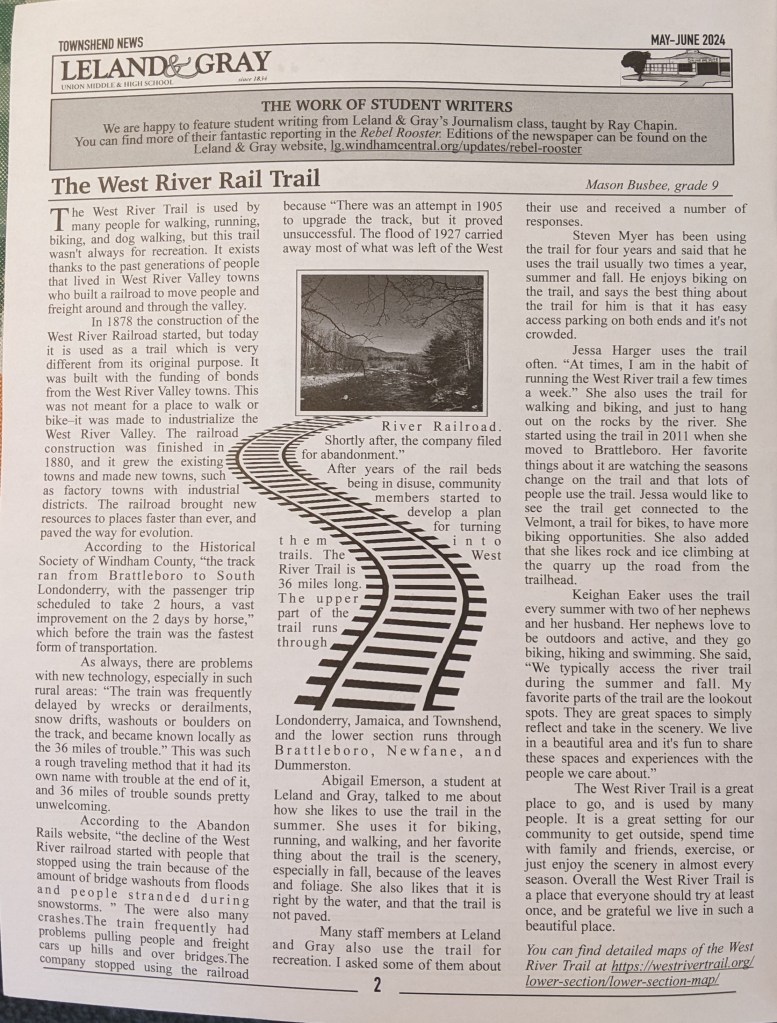
A history of The West River Rail Trail, written by Mason Busbee.
The West River Trail is used by many people for walking, running, biking, and dog walking, but this trail wasn’t always for recreation. It exists thanks to the past generations of people that lived in West River Valley towns who built a railroad to move people and freight around and through the valley.
In 1878 the construction of the West River Railroad started, but today it is used as a trail which is very different from its original purpose. It was built with the funding of bonds from the West River Valley towns.
This was not meant for a place to walk or bike–it was made to industrialize the West River Valley. The railroad construction was finished in 1880, and it grew the existing towns and made new towns, such as factory towns with industrial districts.
The railroad brought new resources to places faster than ever, and paved the way for evolution. According to the Historical Society of Windham County, “the track ran from Brattleboro to South Londonderry, with the passenger trip scheduled to take 2 hours, a vast improvement on the 2 days by horse,” which before the train was the fastest form of transportation.
As always, there are problems with new technology, especially in such rural areas: “The train was frequently delayed by wrecks or derailments, snow drifts, washouts or boulders on the track, and became known locally as the 36 miles of trouble.”
This was such a rough traveling method that it had its own name with trouble at the end of it, and 36 miles of trouble sounds pretty unwelcoming. According to the Abandon Rails website, “the decline of the West River railroad started with people that stopped using the train because of the amount of bridge washouts from floods and people stranded during snowstorms.”
The were also many crashes. The train frequently had problems pulling people and freight cars up hills and over bridges. The company stopped using the railroad because “There was an attempt in 1905 to upgrade the track, but it proved unsuccessful. The flood of 1927 carried away most of what was left of the West River Railroad. Shortly after, the company filed for abandonment.”
After years of the rail beds being in disuse, community members started to develop a plan for turning them into trails. The West River Trail is 36 miles long. The upper part of the trail runs through Londondary, Jamaica, and Townshend, and the lower section runs through Brattleboro, Newfane, and Dummerston.
Abigail Emerson, a student at Leland and Gray, talked to me about how she likes to use the trail in the summer. She uses it for biking, running, and walking, and her favorite thing about the trail is the scenery, especially in fall, because of the leaves and foliage. She also likes that it is right by the water, and that the trail is not paved.
Many staff members at Leland and Gray also use the trail for recreation. I asked some of them about their use and received a number of responses. Steven Myer said he has been using the trail for four years and said that he uses the trail usually two times a year, summer and fall. He enjoys biking on the trail, and says the best thing about the trail for him is that it has easy access parking on both ends and it’s not crowded. Jessa Harger uses the trail often. “At times, I am in the habit of running the West River trail a few times a week.” She also uses the trail for walking and biking, and just to hang out on the rocks by the river. She started using the trail in 2011 when she moved to Brattleboro. Her favorite things about it are watching the seasons change on the trail and that lots of people use the trail. Jessa would like to see the trail get connected to the Velmont, a trail for bikes, to have more biking opportunities. She also added that she likes rock and ice climbing at the quarry up the road from the trailhead. Keighan Eaker uses the trail every summer with two of her nephews and her husband. Her nephews love to be outdoors and active, and they go biking, hiking and swimming. She said, “We typically access the river trail during the summer and fall. My favorite parts of the trail are the lookout spots. They are great spaces to simply reflect and take in the scenery. We live in a beautiful area and it’s fun to share these spaces and experiences with the people we care about.”
The West River Trail is a great place to go, and is used by many people. It is a great setting for our community to get outside, spend time with family and friends, exercise, or just enjoy the scenery in almost every season. Overall the West River Trail is a place that everyone should try at least once, and be grateful we live in such a beautiful place.
About the author: Mason Busbee is a journalism student at Leland and Gray High School, Townshend, VT. He wrote this article in May 2024.


 THE WEST RIVER TRAIL